
Corporations Are People, My Friend: How the Economics of Incarceration Found Its Next Market
There is a longstanding American instinct to describe policy as the product of principle, law, order, safety, and the abstract promise of justice. Beneath that language, however, sits a more operational reality. Policy often follows incentives. Few systems expose that truth more clearly than incarceration, where public authority and private enterprise have, over time, formed a mutually reinforcing relationship. Once confinement became something that could be measured in contracts, scaled through capacity, and forecast in earnings, the people inside the system ceased to be only defendants or detainees. They became units within a revenue model.
That dynamic did not begin with immigration enforcement. It was visible decades earlier in the rise of mass incarceration during the drug war, when expanding criminal enforcement collided with a rapidly growing infrastructure designed to contain it. The premise was simple and quietly powerful. When a system is structured to monetize confinement, it develops an ongoing requirement for volume. When private prison companies trade on Wall Street, their value is tied to their occupants. If violent crime alone cannot supply that volume, policy adjusts. Enforcement priorities shift. Sentencing frameworks expand. The definition of what constitutes a punishable offense broadens until the pipeline is sufficiently fed. Incarceration extended downward to include nonviolent drug offenses during the so-called War on Drugs.
This is precisely what occurred at the height of that period. Enforcement did not remain fixed at the level of major trafficking networks or organized criminal enterprises. It moved steadily downward toward low-level possession, toward nonviolent offenses, and toward conduct that, in retrospect, appears far less aligned with the rhetoric that once justified its punishment. The escalation was not accidental. It was systemic. A larger enforcement apparatus required a larger intake.
I first encountered this reality while working on the documentary project American Drug War: The Last White Hope in the late 2000s. Until then, I had no awareness that private prisons existed. That work led me to broader critiques, including those explored in The Corporation, and the realization was jarring. In a corporate framework, the obligation is to maximize profit and expand margins. Applied to incarceration, that logic reframes detention itself. If profitability depends on occupancy, then detainees become a financial input rather than simply a legal outcome.
I also thought about how, in the weeks following the death of University of Maryland basketball star Len Bias in June 1986, Congress moved with unusual speed to pass sweeping anti-drug legislation that would reshape federal sentencing for decades. In full disclosure, we lived next to each other on campus for a year. Bias died from a cocaine-related overdose just days after being drafted by the Boston Celtics, and his death was widely publicized as emblematic of a growing national drug crisis.
In response, lawmakers advanced what became the Anti-Drug Abuse Act of 1986, which introduced mandatory minimum sentencing for drug offenses. The law established fixed prison terms tied to drug type and quantity, most notably creating the 100-to-1 sentencing disparity between crack and powder cocaine. Although later reporting indicated that Bias had used powder cocaine rather than crack, the legislation had already cemented a framework that dramatically expanded incarceration for drug offenses. Passed with overwhelming bipartisan support in an election year, the law reflected a rapid policy response driven as much by political urgency and public perception as by detailed legislative deliberation, marking a pivotal shift toward rigid sentencing structures in the broader escalation of the War on Drugs.
The transformation of cannabis laws across the United States has since exposed that earlier period with unusual clarity. What was once treated as a serious criminal offense is now, in many jurisdictions, a regulated commercial activity. Entire industries have emerged around behavior that previously contributed to arrest rates, court dockets, and prison populations. The implications are not merely cultural. They are structural. When a category of offense that once fed the incarceration system begins to shrink, the system itself does not simply dissolve. It adapts.
That adaptation is now most visible in immigration detention.

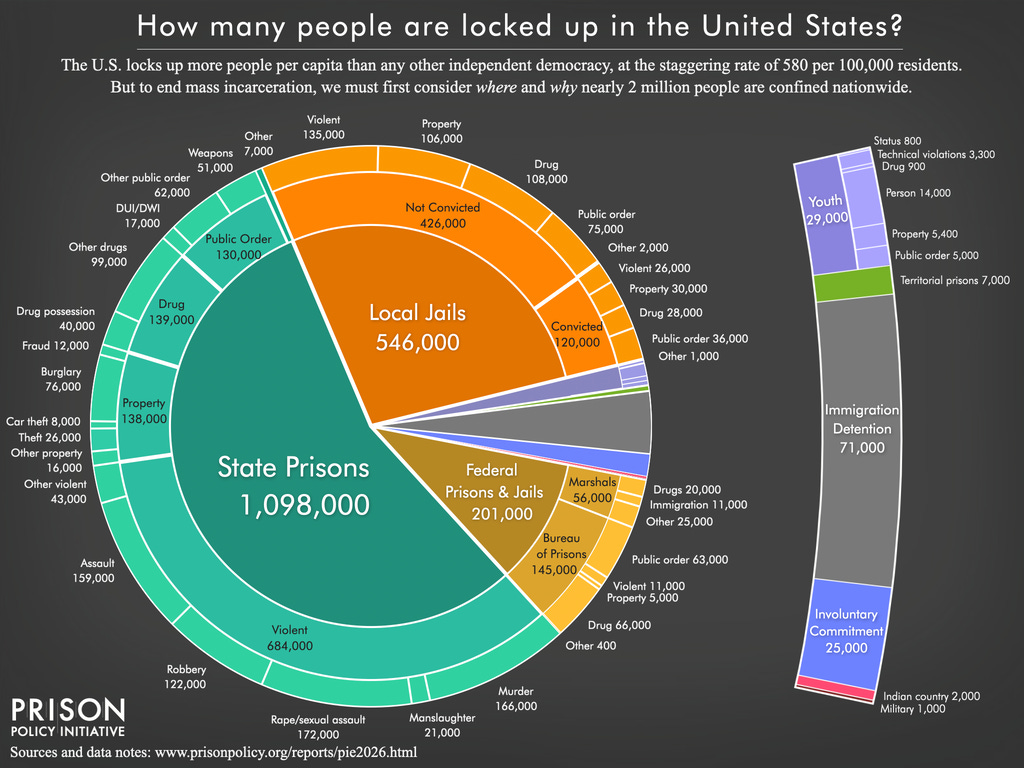
Over the past several years, the United States has expanded immigration enforcement capacity, particularly in detention. This expansion is measurable in rising detainee populations, increased federal appropriations, and the reopening or scaling of facilities across the country. Crucially, the majority of that infrastructure is not directly owned or operated by the federal government. Instead, it is managed through a network of private companies and contractual arrangements that function, in practical terms, as extensions of the public system.
This is where the modern detention economy diverges from older conceptions of incarceration while preserving its core logic. Approximately ninety percent of individuals held in immigration detention are housed in facilities operated by private entities or through agreements with local jurisdictions that mirror private operational models. The structure is not incidental. It is fundamental. These systems rely on occupancy as a primary driver of revenue, creating a built-in incentive to keep beds filled.
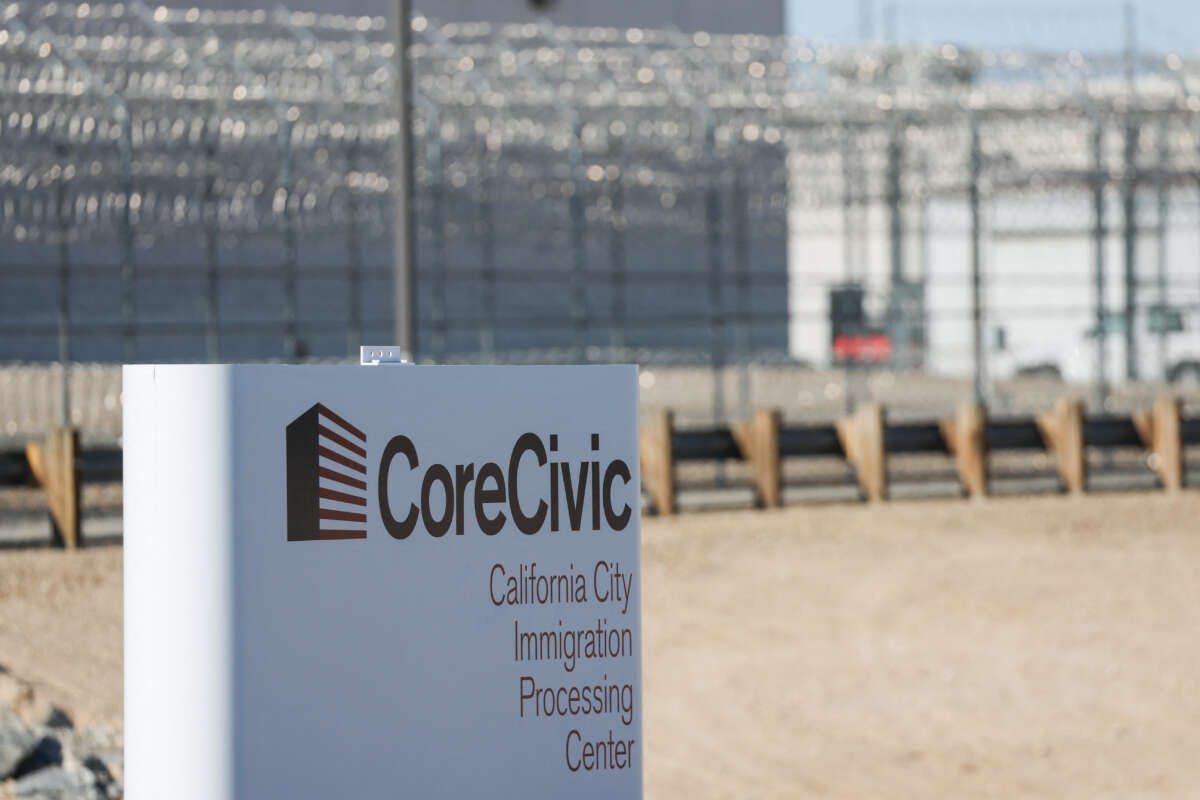
At the center of this system are two dominant players, CoreCivic and GEO Group. Both have experienced substantial revenue growth in recent years, driven in large part by expanded immigration detention contracts and the reopening or scaling of facilities to meet demand. Their business models are not passive. They are directly tied to policy decisions, enforcement trends, and the steady flow of detainees into the system.
Over time, it became clear that this is not an anomaly but a normalized practice. These companies operate or manage hundreds of private prison and detention facilities across the United States. Yet for many people, the public narrative has long suggested the opposite, that incarceration is simply a financial burden on society. In reality, for certain entities, it has functioned as a sustained and highly profitable industry for decades.
The ethical implications are difficult to ignore. The system raises questions about continuous occupancy, labor practices, conditions of confinement, and the broader human cost. When profitability intersects with incarceration, the line between justice and economic incentive becomes increasingly blurred.
At the risk of sounding hyperbolic, it is necessary to consider where this logic leads when taken to its full extent. The issue is not purely theoretical. It is visible in documented practices that continue to exist within the United States today.
The most frequently cited example is the Louisiana State Penitentiary, widely known as Angola. Built on the grounds of a former slave plantation, Angola continues to operate large-scale agricultural programs in which incarcerated individuals work the land, including crops such as cotton. The historical parallels are unavoidable and raise serious questions about how such practices persist within a modern correctional framework.
A second facility often referenced is the Mississippi State Penitentiary, known as Parchman Farm. It has a long and well-documented history as a prison farm where inmates cultivated crops, including cotton. While contemporary evidence is less definitive regarding identical practices today, the structural model of agricultural labor within incarceration remains part of its legacy.
Across multiple states, agricultural prison labor continues in various forms. While not every facility mirrors Angola directly, the broader pattern remains. The intersection of confinement, labor, and economic incentive, particularly within regions historically tied to plantation economies, demands scrutiny.
These concerns deepen when viewed alongside documented cases of wrongful conviction. Work by organizations such as the Innocence Project has shown how flawed evidence and improper practices can place individuals into these systems unjustly. When those realities intersect with labor structures that echo historical exploitation, the implications become difficult to dismiss.

That is how I first became aware of prison plantations and cotton picking within correctional facilities this day and age. They were not there to report on that practice; they came across it unexpectedly while filming the prison grounds. The discovery surprised everyone. The optics were striking and difficult for me to ignore.
The detention economy is not contracting. It is expanding. Increased federal funding leads to increased capacity, which requires operators. More beds lead to more contracts. More contracts lead to higher revenues. That cycle reinforces the system’s durability.
The model has also evolved beyond physical detention. It now includes electronic monitoring, transportation, and supervision. What is often described as an alternative to detention may change the form of control, but not its financial structure. Whether confined or monitored, individuals remain part of a system that can be contracted, billed, and scaled.
The political dimension is unavoidable. Private companies do not create immigration law, but they operate within and benefit from it. As enforcement priorities intensify, demand rises. Corporate actors respond by expanding operations, creating a feedback loop between policy and profit.
At its core, the debate raises a fundamental question. Can a system built to generate profit from confinement coexist with principles centered on justice and due process. Supporters argue these systems provide capacity and efficiency. Critics point to structural incentives that favor expansion over restraint.
These tensions are not new. They reflect a broader history in which punishment and economic function have long been intertwined. The legal framework permitting compulsory labor remains in place, continuing to generate scrutiny.
Race intersects with these dynamics in ways that are difficult to ignore. It did so during the drug war and continues within immigration enforcement. The system does not require explicit intent to produce unequal outcomes. Its structure often ensures them.
What distinguishes the present moment is not the existence of these dynamics, but their visibility. As one source of volume declines, another emerges. The system recalibrates, but it persists. The language used to justify it remains consistent. Public safety, border security, and the rule of law are all invoked.
Yet operationally, the system is driven by contracts, metrics, and revenue. Each detainee represents capacity. Each filled bed represents income.
A serious national conversation would confront this reality directly. It would recognize that the incarceration economy has not disappeared. It has evolved. It would acknowledge that reliance on private capacity embeds market incentives into enforcement. And it would examine the consequences of sustaining such a model.
The continuity from the drug war to the current detention expansion is not incidental. It is structural. The statutes have changed. The populations have shifted. The rhetoric has evolved. But the underlying incentive remains intact. Somewhere within that system, a ledger is being balanced. On that ledger, the line between human necessity and economic opportunity continues to blur.