“Corporations Are People, My Friend” — When Profit Becomes a License to Exploit the Planet, From Taiji’s Coves to the Clouds Above Us
“Corporations are people, my friend.” That line on so many words, gets repeated whenever companies want constitutional protections, political influence, and the legal armor of personhood. It is cited when executives defend lobbying budgets, campaign spending, and regulatory carve-outs.
But if corporations truly want to be treated like people, then they must also be judged like people. People have morals, which are selectively left out of the conversation. Instead, the focus is placed on profits and profit margins as the end-all, be-all—by law. And, therefore should be judged by the harm they enable, by the consequences they ignore and by what they are willing to profit from when no one is watching.
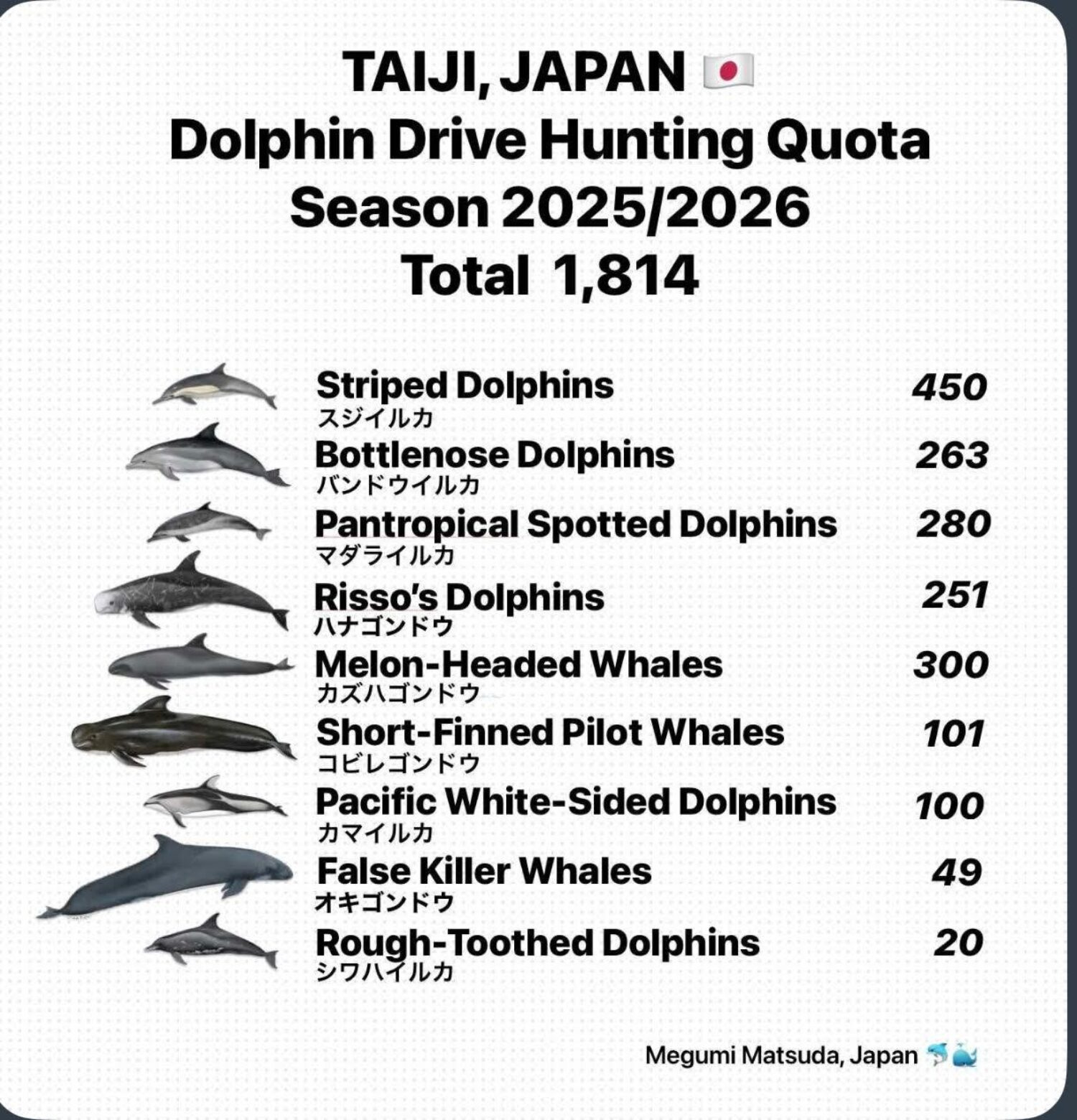
This week, as the Taiji dolphin hunting season enters its final three weeks, and as a new generation of climate-tech companies begins pitching lawmakers on altering the atmosphere itself, corporate responsibility is no longer an abstract theory. It is visible. It is operational. And it is quietly reshaping both wildlife exploitation and environmental governance.
The uncomfortable truth is this that today’s corporate responsibility crisis is not only about what companies extract from the planet. It is about what they feel entitled to control.
And nowhere is that more clear than in a small cove in Japan—and increasingly, in the skies above us.
For a few minutes of applause, a lifetime of confinement
Let’s strip away the branding language.
At the consumer end of the dolphin captivity industry, the product is remarkably simple:
A dolphin jumps through a hoop.
Gee— is that fun for people?
A whale or dolphin swims in a synchronized arc, which you can see on any whale-or dolphin-watching excursion in its own natural environment, let alone on your own if you are an expert kayaker or sailor.
An animal balances a ball on its nose while music plays—which, once again, I have to ask: is that really fun for humans with brains?
Set aside that the entire spectacle lasts minutes wheras the captivity lasts decades.
We have built an international business model around one of the lowest and most disposable forms of entertainment imaginable—watching highly intelligent, socially complex animals perform mechanical tricks for a brief burst of novelty.
That fleeting moment of applause is used to justify removing wildlife from the open ocean—or killing those who cannot be sold.
This is not meaningfully different from the circus industry of the past, when lions were forced through fire hoops and elephants were trained to perform unnatural behaviors like standing on two legs. The props changed. The marketing improved. The ethics did not.
Behind every tank, there is a supply chain
The public only sees the polished end of the pipeline.
They see the trainers.
They see the music.
They see choreographed routines and curated lighting.
They are told its some form of conservation.
They do not see the cove.
They do not see the boats moving into position after luring them into their watrers, from international waters.
They do not see nets closing.
They do not see family groups torn apart, individuals selected for sale, and the remaining animals driven toward slaughter.
But that is the direct connection between a modern dolphin show and the coastal town of Taiji.
Taiji is not operating in isolation. It is one of the most visible and persistent collection points feeding the international captivity industry.
And as the 2025–2026 season moves toward its close, independent cove monitors on the ground are again documenting what the brochures will never show—live drive hunts, capture operations, temporary holding facilities, and transfers into commercial pipelines which is all brutal for the animal.
Taiji is ground zero for live dolphin sales.
And live dolphins—not meat—are where the real money is.
The economics no attraction wants to explain is that yes, some dolphins are killed and their meat is sold locally.
But the real profit comes from capture, confinement, training, international resale and long-term performance contracts where they are fed to work while being housed in pools the size of the one my back yard so to speak.
A single live dolphin sold into the global display industry can generate revenue that eclipses what could ever be earned through local food markets.
This is not subsistence. This is not heritage fishing.
This is a modern wildlife extraction industry built around entertainment demand.
It is a corporate supply chain.
It is slavery in the sense that we did this to people for centuries, until it was made illegal to enslave humans. That exploitation then shifted to animals and wildlife, where animals are taken for free and put to work for the rest of their lives while being fed and given only minimal shelter. That honestly sounds a lot like parts of South Carolina in the past to me.
Corporate responsibility does not stop at the ticket booth
Here is where the corporate responsibility conversation becomes unavoidable.
Every time a marine park sells a ticket. Every time a “swim-with” attraction markets a premium encounter and every time a private photo session or therapeutic interaction program is promoted.
Demand is reinforced.
The responsibility does not end when an animal arrives at a facility.
It begins there.
If a company profits from displaying captive dolphins, it inherits ethical responsibility for where those animals came from and how they were obtained.
Silence is not neutrality. Silence is supply chain approval.
The most important pressure is coming from inside Japan
One of the most critical realities emerging from this season is that meaningful change in Taiji will only come through domestic engagement.
International outrage alone has limits. What moves policy in Japan is Japanese public awareness, Japanese legal action, and Japanese civic pressure.
I sent letters to Caroline Kennedy and to many others, and days later she spoke out against the industry. It’s one of those claims to fame I never got credit for igniting—but even that didn’t change anything in the broader scheme of things.
Without independent observers, the industry controls the narrative. And narratives are one of the most profitable assets any corporation can own.
Why awareness still matters—even after The Cove which an Oscar back in the early to mid 00’s. Many people first learned about Taiji through the documentary released more than fifteen years ago.
But that moment has faded from public memory.
An entire generation has grown up without understanding that drive hunts continue, that live capture still feeds global entertainment markets, and that dolphin shows remain commercially connected to wild removal.
Recent real-time coverage consistently produces the same response from new audiences: They did not know. They had never heard of the hunts. They had never connected captivity to wild capture.
And they do not realize what it actually takes to get a dolphin or a whale into these facilities from the ocean. This is not Star Trek, where molecules are broken down and you instantly reappear in a different place. That is not a real thing.
Awareness is not obsolete. It is incomplete.
Japan is now one of the most critical markets. Across many regions, public attendance at traditional marine parks has dropped sharply. Several high-profile facilities have closed or collapsed financially.
But Japan remains one of the strongest domestic markets for dolphin display and interactive programs. That makes public engagement inside Japan the front line of this issue. It is where change becomes politically possible.
Corporate personhood demands corporate accountability and again, if corporations want to be treated like people, then they must accept the moral standards we apply to people (we should literally add a moral clause to the 13th Amendment).
People are held responsible for knowingly participating in harm. People are expected to examine the origins of what they buy and sell. People are not allowed to hide behind “we didn’t look.”
The connection between dolphin drive hunts and entertainment facilities is well documented. The financial incentives are openly discussed. This industry can no longer claim ignorance. A familiar pattern, dressed up as entertainment
Human slavery was eventually outlawed because societies recognized that profit does not justify ownership of another sentient being.
What we are watching today is a quieter, sanitized version of the same logic:
- Remove freedom.
- Control movement.
- Extract performance.
- Monetize bodies.
Only this time, the victims are wildlife.
And the language of “family experiences,” “education,” and “fun” is used to mask commercial exploitation.
What real corporate responsibility looks like in wildlife entertainment and the true corporate responsibility in this sector would include:
- ending sourcing from wild capture pipelines
- phasing out performance-based dolphin programs
- publishing transparent acquisition histories
- investing in non-exploitative education and conservation
- supporting in-country protection initiatives
Anything less is branding and not responsibility.
But the corporate responsibility crisis does not stop in Taiji by any means, it is now moving into the atmosphere itself.
When “fixing the weather” becomes the next corporate escape hatch, it feels ripped straight out of a few James Bond 007 films.
This week’s corporate responsibility conversation also takes a sharp—and, at least in my eyes, deeply unsettling—turn, because I just do not think it’s right. Something ain’t right about this, just like fracking ain’t normal to do to our Earth at least in my eyes and without any true science. This is just me thinking something ain’t right with this either.
At Sustainable Action Now yesterday, I did a story that sounds more like speculative fiction than public infrastructure as this company is flying directly into clouds to deliberately trigger rainfall.
If corporations are people, my friend, then we must ask a far harder question: When companies begin intervening directly in planetary systems, what does responsibility even mean because once you move from extracting land, water, and minerals…to actively manipulating atmospheric processes…you are no longer simply selling technology.
You are shaping how society imagines climate solutions. That is a political act.
Whether the company admits it or not. The business of selling “better weather” is now a thing.
A fast-rising startup now positioning itself at the center of this debate is building an integrated weather-modification platform aimed at drought-stricken regions.
The company does not claim to stop climate change. It explicitly markets itself as part of the climate adaptation economy.
That distinction matters.
Its business model is built around managing the consequences of environmental disruption—not preventing it. Cloud seeding is being modernized. This is not a revival of the experimental programs of the mid-20th century or that X-File where the dude causes rain.
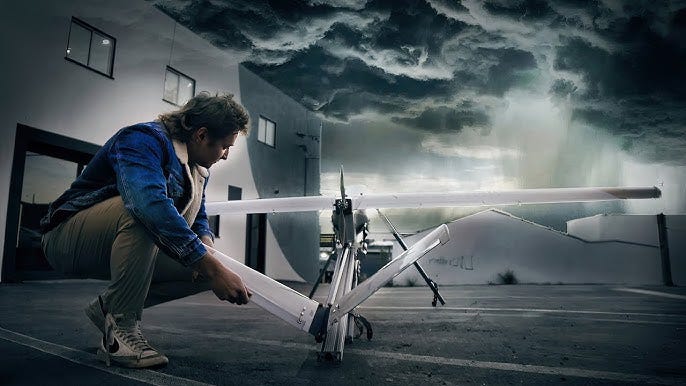
The company is developing an operational system built on three pillars which are unmanned aircraft capable of flying directly into active cloud systems, dispersing ice-nucleating particles such as silver iodide. Mobile radar and atmospheric sensing equipment to measure cloud structure and post-operation precipitation behavior. And, artificial intelligence models designed to identify which clouds are “seedable,” when interventions are likely to work, and how flight paths should be adjusted in real time.
The pitch is simple. Cloud seeding—upgraded for the algorithmic age. A permanent market built on permanent disruption. The company’s early commercial work targets agricultural regions and water districts facing declining reservoirs and unstable precipitation patterns.
In other words, the business model assumes continued climate instability.
Not a temporary emergency or a permanent market.
When disasters strike, technology becomes an easy scapegoat. After catastrophic flooding in Texas last summer, online conspiracies quickly attempted to blame cloud-seeding operations.
Those claims were false. Cloud seeding cannot create storms. It cannot generate hurricanes. It cannot cause large-scale flood events.
It can only influence precipitation within already-existing cloud systems, and only within narrow margins.
But the backlash revealed something far more important. Public fear is increasingly being redirected away from structural climate failures—and toward visible technologies.
That shift matters.
From farm pilots to federal policy. By early 2026, this startup’s strategy had shifted from agricultural pilots to federal lobbying.
The policy agenda focuses on regulatory pathways for unmanned in-cloud aircraft
drone certification frameworks and national drought-response planning. Cloud seeding is now being positioned as public infrastructure.
Not a niche experiment. It is now agenda-setting disguised as innovation and therfore, from a corporate responsibility perspective, the real product being sold is not rainfall.
It is reassurance.
It is the promise that communities can manage climate disruption without confronting the economic systems driving it. That promise is politically powerful.
The strongest case in favor of cloud seeding is that supporters argue that carefully governed cloud seeding may offer modest benefits in water-stressed regions. Small increases in snowpack and precipitation could help stabilize agriculture and supplement reservoirs.
Compared with large desalination projects, the energy footprint is relatively small and deployment is rapid.
As an adaptive tool, it may have limited tactical value. But that is where the responsible framing must stop. The risks rarely highlighted in startup pitch decks
Serious concerns remain to me at least.
Atmospheric equity matters because we started by owning land after taking it for free. Then we began leasing our coastlines, like the examples mentioned above in Taiji, Japan. Further, the polluters of the world are allowed to “rent” our air—given permits to spew smoke and pollution every day at certain times purchased or leased. And now, someone may be able to own a cloud or two.
Or, better yet, who controls shared clouds?
If multiple regions begin competing for precipitation, cloud seeding becomes a new form of resource conflict.
Long-term chemical accumulation is also my issue because granted that silver iodide is widely considered low-toxicity at operational concentrations, but large-scale, long-term accumulation in soil and groundwater remains poorly studied.
And most critically, the moral hazard problem.
Visible technological interventions can quietly weaken political pressure for the far harder work of cutting fossil fuel production, rebuilding transportation systems, modernizing power grids, and restructuring industrial supply chains.
Technology that treats symptoms can displace urgency for structural reform which is where I think is where the science actually stands for real. Most peer-reviewed research suggests cloud seeding may increase precipitation by roughly five to fifteen percent under specific conditions.
At a planetary scale, the impact is marginal. Cloud seeding is a localized optimization tool. The same goes for eating dolphins or watching animals jump through a hula hoop.
This is not a climate solution BTW, what this reveals about modern corporate responsibility is that from Taiji’s coves to cloud-seeding drones, the pattern is strikingly similar.
Corporate innovation increasingly focuses on controlling nature, optimizing scarcity
and monetizing disruption, rather than preventing harm in the first place.
Rainfall manipulation cannot replace emissions reduction just like dolphin shows cannot justify wildlife extraction.
Yet both industries are quietly sustained by the same logic that if it generates revenue, responsibility becomes optional.
Corporations are people — and people are accountable — except with moral values. If corporations truly deserve the rights of being a full person, then they must also accept the standards we expect of people.
Not only whether their technology works.
But what kind of future their business model normalizes.
Cloud seeding may eventually play a narrow, carefully governed role in drought management. But it cannot replace climate mitigation. Just as dolphin entertainment cannot replace conservation.
In both cases, profit is attempting to redefine what “solution” is allowed to mean.
And corporate responsibility is no longer about public relations.
It is about truth.
About limits.
And about whether we are willing to admit that some business models—no matter how polished—are built on exploitation, not progress.