So, when were we great? When were we last the leading nation in a progressive sort of way?
Corporations Are People, My Friend
Economics Today, and Dating Back to the ’70s
So, when were we great? When were we last the leading nation in a progressive sort of way?
Don Lichterman · Sep 9, 2026
First off, I really have to find some way to check my spelling on here. I forget every time, and then I see all the typos, which begs the question: why is there no built-in spell check on Substack? I’m guessing it’s part of the paid feature, and I’m not paying someone to write for them.
I’m almost caught up on writing, and honestly, I wasn’t even sure what to talk about today. There’s so much corrupt stuff happening constantly that it’s not like I can’t keep up with it. It’s more that I keep coming back to the last thing I said on the On the Rampage episode after the election: that watching him and his people get mega rich without really trying isn’t going to affect how I live. For a while it did genuinely annoy me, and I wasn’t totally sure why. Trump and his people getting rich fast without doing any real work for it, while I’m sitting here wondering where my next meal is coming from and working twelve to fifteen hours a day, that combination used to make me furious.
But for some reason, those feelings don’t get to me the same way anymore. I’m not sure exactly when that shift happened. I’m actually trying hard to get angry about it again, and it just doesn’t land the way it used to.
The only things that actually affect me have cost me maybe tens of dollars more than I would’ve spent before he was president. Gas prices, even with the multiple hikes, have only run me about ten dollars more than two years ago. Food I can work around in a lot of ways. If I pay more to eat out or order delivery, I honestly don’t track it closely because I can’t cook anyway. What I can point to are the necessities. Shampoo, conditioner, deodorant, all noticeably higher than five years ago. There was a stretch where the only deodorant I could get, since I refuse to buy anything tested on animals, was $2.89. Not that long ago, either. Now it’s closer to six dollars, maybe more. Shampoo hasn’t jumped as much for me, maybe a dollar or two.
Set all of that aside, though, because the real issue isn’t the president. And remember, this one lands on the Democrats, who still don’t have a clue. I heard someone say, on air, that Americans are smart, and honestly, that line is my nightmare scenario. Because until Democrats stop repeating that, they’re doomed. When exactly were we smart? Can someone point to the moment America was ahead of the game instead of playing catch-up year after year? Was it when we voted in the current president? Is that supposed to be the proof that we’re smart as a country?
That’s genuinely what gets to me: hearing quintessential Democrats say that sentence on major news outlets on a regular basis. That line is the kiss of death.
So when were we great? When were we last the leading nation in a progressive sort of way? We’re ranked anywhere from sixth to eightieth now, depending on the metric, and we’re not number one in much of anything, including film and television, categories we used to dominate globally, even against Bollywood, which puts out a new film or show every three minutes. China is light-years ahead of us at this point, with flying cars, vehicles that shake snow off themselves, and full driverless fleets already on the road.
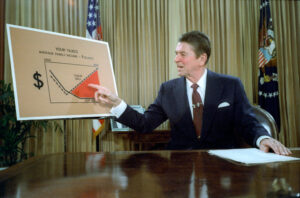
This is true trickle-down theory, executed with precision, and it’s exactly where we are right now. The current president said as much himself, in so many words, while running for office. It’s not just what he said either. It’s how the whole operation behaves. When this idea first entered my life as a kid, it pretty much failed under Reagan the first time around.
If you’re looking for the source of the economic anger right now, a lot of it comes down to the growing gap between how the top of the economy performs and how it actually feels for a normal household. Stocks are sitting at record highs, similar to the run-up before COVID hit during the last term. Corporate earnings are high too, and if a company managed to skate through the 2007–2008 financial crisis largely intact, it’s only compounded that worth since. Somehow earnings keep climbing while wages keep falling, and I genuinely don’t understand the full mechanics of how that math works. It also, admittedly, contradicts what I just said about trickle-down being fully in place today.
What we have is a K-shaped economy: one line trending up for the wealthy, another trending down for households that depend on wages. I’d call it a modern version of the old trickle-down premise, that enriching the top of the ladder eventually benefits everyone underneath it. And I should be upfront about something I keep skipping past: I think we’re really only at the beginning of what I’d call this era of trickle-down economics, not the middle or the end of it.
At this point, deep into it as we are, the honest problem isn’t that people are making a lot of money. Nobody actually cares about that, so long as it’s fair for everyone else too. That’s the whole issue. Right now the winning side of that K curve is playing a game that feels rigged the same way it did in 2008. Crypto is a good example. Certain people were positioned to make money regardless of outcome or market condition, and they built enormous fortunes out of almost nothing, without any real exposure to loss. That’s the thing about how this crowd operates: they’ve figured out how to generate massive returns while carrying almost no risk. The justification is always domestic manufacturing, production, and infrastructure, and I’m not seeing meaningful progress on any of those fronts. If anything, given how fast AI is consolidating industries right now, I’d assume the opposite is happening. They’ll also tell you they’re cutting junk fees and price gouging, and that low structural unemployment proves the whole thing is working from the middle out and the bottom up.
I lived through Supply Side Economics as a kid, during the early Reagan years, and at the time it looked like evidence that the theory worked. The top tax rate dropped from 70 percent to 28 percent, and the country saw strong growth alongside roughly 20 million new jobs.
Since then, a fifty-year study spanning eighteen countries out of the London School of Economics found that tax cuts for the wealthy increased inequality without meaningfully boosting job creation, lowering unemployment, or driving long-term GDP growth. Separately, IMF research found that when income share rises for the wealthy, it actually drags overall growth down, while gains for the poor and middle class push growth up.
Set aside the failure of the Hoover era in the 1920s and ’30s, when the so-called horse-and-sparrow tax cuts did nothing to prevent or soften the Great Depression. In my own lifetime, the pattern shows up again and again. The Bush tax cuts of 2001 and 2003 promised a wave of business investment and instead delivered weak job growth, ballooning deficits, and the runway for the 2008 crash. Then came the Kansas experiment in 2012, when Governor Sam Brownback zeroed out taxes for a huge swath of businesses. Growth lagged so far behind neighboring states that the state’s own Republican legislature repealed the cuts in 2017. The 2017 Tax Cuts and Jobs Act under Trump promised broad wage gains across the board, but a Roosevelt Institute study found executives captured 81 percent of the resulting wage growth, with most of the remainder funneled into stock buybacks rather than expanded operations or new hiring.
Today, the pattern is repeating itself again. Civic Skunk Works reported last month, in August 2026, that second-quarter GDP growth slowed to 1.5 percent amid energy volatility and supply-chain strain, real-world evidence that protecting corporate profits hasn’t shielded ordinary people from a slowdown. Time has pointed out that the way we talk about economics today overstates total GDP growth while glossing over how unevenly that growth actually gets distributed. And an essay in Aeon ties current policy directly to rising housing costs and decaying infrastructure.
Taken together, over the course of my lifetime, corporate value has grown to almost unimaginable levels while the pace of new job creation has thinned out, and wages, by every account I can find, are down. The One Big Beautiful Bill, now in its first tax year, locks in permanent tax cuts. It extends, expands, or newly implements 4.5 trillion dollars in breaks.
Same script. Different decade. I’m just not sure how many more times we run it before somebody in charge admits it was never actually about the middle.