Corporations Are People, My Friend: The SAVE America Act is not a technical adjustment to election law
This was my post for the week before I was sidetracked by the Laguna Hills story but anyway, I wrote about this at Explore New Jersey and at the Sunset Daily News the other day.
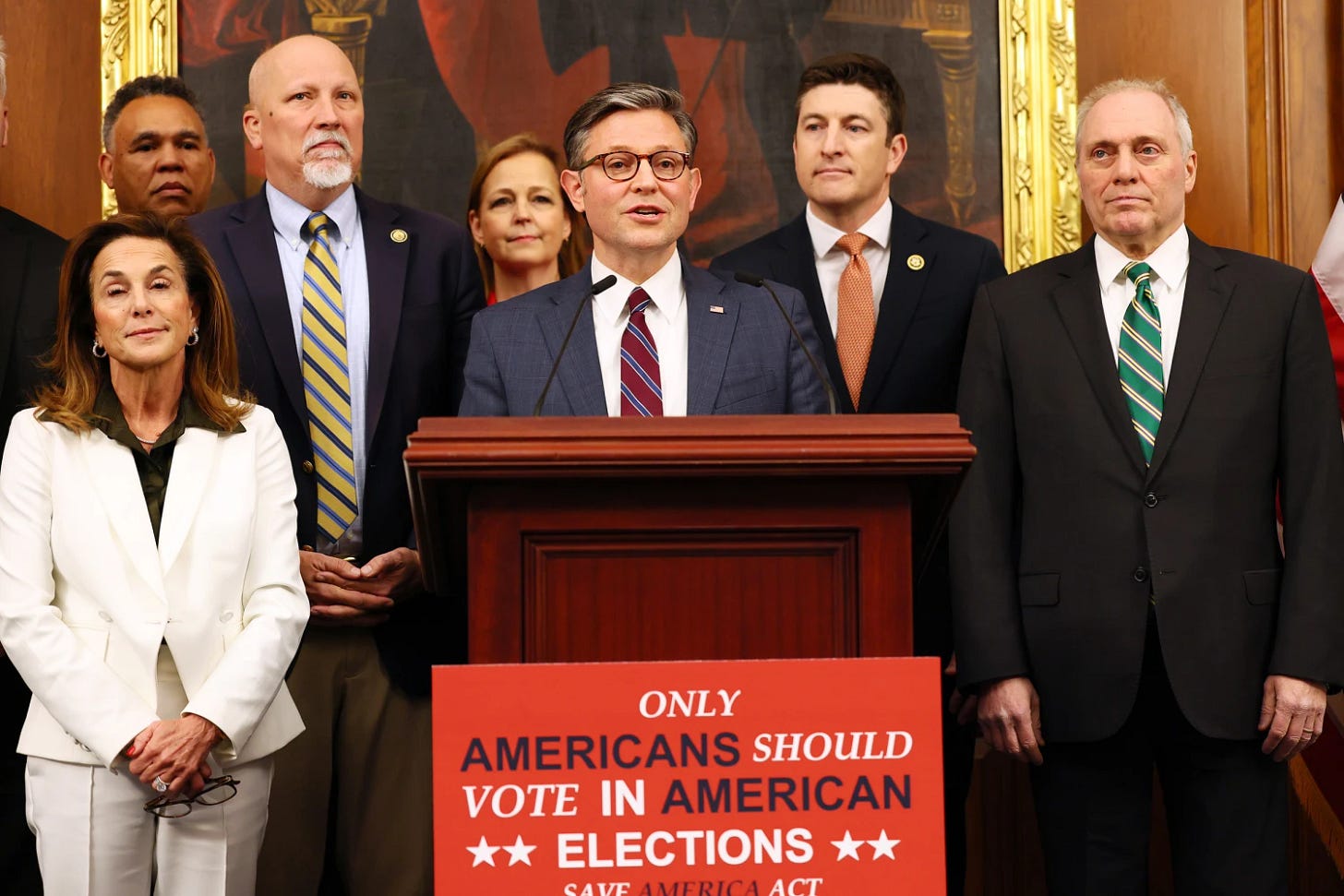
The SAVE America Act is not a technical adjustment to election law. It is a proposal that, if enacted in its current form, would force a direct and immediate overhaul of how people in New Jersey register to vote and how they continue to participate, particularly those who rely on vote-by-mail. For a state that has already built a system designed around accessibility, efficiency, and minimal friction, the implications are not subtle. They are disruptive by design.
New Jersey’s current voting infrastructure is built on simplicity and scale. Residents can register online, by mail, or through the Motor Vehicle Commission using a driver’s license number, a non-driver ID, or the last four digits of a Social Security number. The state verifies that information electronically through existing databases. Once registered, voters remain active without needing to repeatedly re-prove identity. The system is designed to reduce barriers, not introduce them.
That design extends directly into vote-by-mail. New Jersey operates under a permanent, no-excuse vote-by-mail system. Voters can opt in once and receive ballots automatically for every election. There is no requirement to justify the request, no need to appear in person, and no ongoing administrative burden placed on the voter. The process is linear as the ballot arrives, the ballot is completed, and the ballot is returned. That simplicity is the reason participation has remained consistent and scalable. That same simplicity is why the President himself uses it in Florida every election period. He uses vote-by-mail, so what is good for the so-called king should be good for his constituents and his peasants.
The SAVE America Act replaces that structure with a documentation-first model. Under the proposal, registering to vote in federal elections would require documentary proof of U.S. citizenship, specifically a passport, birth certificate, or naturalization certificate. A numerical identifier tied to state or federal databases would no longer be sufficient. The burden shifts from verification systems to the individual.
In New Jersey, that shift creates a direct operational conflict. The state issues driver’s licenses to both citizens and non-citizens with legal status, and those licenses do not display citizenship. Under the Act, a driver’s license can only be used for voter registration if the issuing state requires proof of citizenship and indicates that status on the credential. New Jersey does neither. The practical result is that a standard New Jersey license, currently one of the primary tools for voter registration, would be disqualified.
That change alone forces a new process. Registration would move away from online systems and MVC-based enrollment and toward in-person verification tied to physical documents. For new voters, that introduces time costs, access issues, and document retrieval requirements that do not exist today. For people like me, it is not only unacceptable, it is time-consuming and a complete waste of bureaucracy and manpower to implement and execute. I also do not want any change in that regard because, quite simply, this is not a problem we face in the United States. There are no credible reports, beyond misinformation, of widespread cases involving fake IDs being used to vote in American elections.
While widespread voter fraud remains extremely rare, official data from multiple sources, including the Heritage Foundation and state-level audits, confirms that individual cases of illegal voting do occur and are prosecuted.
According to the Heritage Foundation’s Election Fraud Database, there have been 1,620 proven instances of election fraud in the United States between 1982 and 2026. Within that total, cases involving noncitizen voting account for approximately 100 instances between 1982 and 2025. When placed in context, that figure represents an extraordinarily small fraction of total participation, roughly 0.000008% of the approximately 1.3 billion presidential votes cast during that period.
Other forms of fraud show similarly low rates. A 2017 study from the Brennan Center for Justice estimated that voter impersonation, meaning an individual attempting to vote as someone else, occurs at a rate between 0.0003% and 0.0025%. More recent analysis from the Brookings Institution in January 2026 found that mail-in ballot fraud occurs at a rate of approximately 0.000043%, which equates to about four cases per 10 million votes.
Despite the extremely low frequency of voter fraud, individual cases do continue to surface and are actively pursued through the legal system. In 2024, Kim Phuong Taylor in Iowa was convicted on 52 counts of voter fraud related to falsified registrations and absentee ballots. In New Jersey, Craig Callaway was sentenced in 2025 to two years in prison for a scheme involving the fraudulent collection of mail-in ballots. In Kansas, Coldwater mayor Jose Ceballos was charged in November 2025 for illegal voting as a noncitizen. In Georgia, Samunta Shomine Pittman faced 70 felony counts in 2024 for fraudulent voter registration activity.
A closer look at these cases, based strictly on publicly reported information, shows that they do not point to a single partisan pattern. Kim Phuong Taylor’s actions were connected to local Republican political circles, with the fraudulent activity tied to absentee ballots associated with a Republican campaign effort. In contrast, Craig Callaway, a longtime political operative in Atlantic City, has been widely linked to Democratic campaigns, and his ballot-harvesting scheme has been associated with Democratic local political operations.
The remaining cases further reinforce how inconsistent these incidents are in terms of political alignment. Jose Ceballos’ case in Kansas centers on noncitizen voting and does not appear to be connected to any coordinated campaign effort or clearly defined party affiliation. Similarly, the charges against Samunta Shomine Pittman in Georgia involve fraudulent voter registration applications, but public reporting has not consistently tied the activity to a specific party operation. It sounds like they forgot to register.
Taken together, these examples illustrate a broader reality reflected in national data: instances of voter fraud, while real and prosecuted, are isolated and varied. They do not follow a consistent partisan pattern and are better understood as individual violations of election law rather than evidence of coordinated efforts by any single political party.
State-level audits further reinforce how infrequent these cases are when measured against total voter participation. In Michigan’s 2024 election, 15 credible cases of noncitizen voting were identified out of 5.7 million ballots cast, representing approximately 0.00028%. In Georgia, a 2024 audit conducted by the Secretary of State’s office identified 20 noncitizens among 8.2 million registered voters. In Arizona, a review of the 2024 presidential election found 28 fraudulent votes statewide.
Organizations such as the Brennan Center for Justice emphasize that these numbers are far too small to influence election outcomes. At the same time, legal records and investigative databases confirm that instances of fraud, while rare, are real, identifiable, and subject to prosecution when detected.
The pressure does not stop at registration. The proposal also raises the possibility of requiring additional documentation for mail-in voting, including photocopies of qualifying identification submitted with ballots. That fundamentally alters how New Jersey’s vote-by-mail system functions. What is currently a streamlined process becomes conditional on document access and compliance with additional steps.
Each added requirement increases the likelihood of drop-off. That is not a political talking point; it is a consistent administrative reality. When voting systems introduce more steps, more documentation, and more points of failure, participation decreases. This effect is most pronounced among voters who rely on convenience-based systems, mail-in voters, working-class voters with limited time, and individuals who do not maintain immediate access to original citizenship documents.
New Jersey’s system was built specifically to eliminate those friction points. The SAVE America Act reintroduces them at scale.
This is where the frustration becomes unavoidable. For residents who have not had to step into an MVC office in years, who have structured their participation around vote-by-mail, and who operate within a system that already verifies identity effectively, the idea of being pushed backward into document-heavy, in-person processes is not reform. It is regression.
And it raises a larger, unavoidable question about intent and impact.
The United States has a long, documented history of voting laws that reshape participation through procedural requirements. From literacy tests and poll taxes in earlier eras to more modern restrictions that tighten identification or registration pathways, the mechanism is consistent: adjust the process, and participation patterns change. The SAVE America Act fits squarely into that lineage of process-driven change, even as it is framed as standardization.
Supporters argue it is about election integrity. Critics argue it imposes unnecessary barriers in a system where non-citizen voting in federal elections is already illegal and rare, and where existing verification mechanisms are already in place. The disagreement is not over whether elections should be secure, it is over whether the proposed changes solve a real problem or create new ones.
For New Jersey, the answer is tied directly to impact. A system that currently allows residents to register quickly, vote without logistical strain, and remain engaged without repeated bureaucratic interaction would be replaced with one that demands more documentation, more effort, and more compliance.
That is not a neutral shift.
It disproportionately affects people who rely on the current system working as intended, people who vote by mail because it fits their schedule, people who avoid unnecessary interaction with government offices, and people who do not keep passports or birth certificates readily available for routine use.
And for anyone who has lived in New Jersey long enough to understand how the MVC operates, the idea of tying voter access more closely to documentation and in-person verification is enough to trigger immediate pushback. The state has already moved away from that model for a reason.
The current status is clear. The SAVE America Act is not law. It passed the House in 2024 but faces significant opposition in the Senate. New Jersey’s voting system remains unchanged heading into the 2026 election cycle. Registration processes remain intact. Vote-by-mail continues without additional requirements. Ballots will be mailed, received, and counted under the existing framework.
But the proposal defines a direction, and that direction runs directly against how New Jersey has chosen to operate.
For residents who value a system that works without unnecessary friction, the reaction is not complicated. When a functioning process is replaced with one that adds barriers, increases effort, and risks reducing participation, frustration is not just understandable, it is warranted.
Because at a certain point, this stops being about policy language and starts being about reality. And the reality is simple, if you make it harder to vote, fewer people will do it.
We will deal on our own in New Jersey. We are not digressing here.
Today at the Sunset Entertainment & Media Companies
Corporations Are People, My Friend
A Ceasefire, a Declaration of Victory, and the Gap Between What We’re Told and What Actually Changed
Rams Continue Shaping Draft Strategy in Final Weeks
Live Jam Features Fleetwood Mac “Live” on Live From The Vault
Calculated Chaos and Cultural Timing: Federal Moguls’ “Vicarious” Takes Center Stage at Sunset