Corporations Are People, My Friend: Why the Data Already Proves Which Party Governs Better and Why is This so Hard For The dem’s?
For all the money, consultants, polling, and media infrastructure surrounding the modern Democratic Party, there remains a staggering and almost inexplicable failure at the core of its public messaging. The evidence is not hidden. It is not complicated. It does not require advanced political theory or academic modeling. After all, I know it. The record is visible, measurable, and remarkably consistent across more than three decades of modern American history.
And yet, Democrats still struggle to articulate a simple truth: when Democrats govern, the country stabilizes and grows; when Republicans govern, the economy contracts, institutions erode, and long-term damage follows.
This is not ideological opinion. It is statistical reality.
Since 1990, the United States has cycled through alternating administrations. Across that timeline, one pattern repeats with striking consistency: Democratic administrations inherit economic crises and leave the nation stronger; Republican administrations inherit stability and leave the nation weaker.
This alone should be the centerpiece of every campaign message, every policy briefing, every town hall, and every national address.
Instead, it remains oddly underutilized.
Moreover when you listen to the GOP and Trump today, you would think the worlds was ending during the Biden administration. Therefore, the dem’s are so bad at the very thing that GOP is so great at.
Consider the modern timeline.
The Clinton administration entered office following the late-1980s recession and mounting federal deficits. Over two terms, it produced sustained GDP growth, job creation, rising household incomes, and eventually budget surpluses—surpluses that modern Americans now forget even existed.
The subsequent Bush administration inherited a stable economy and turned it into two prolonged wars, a ballooning deficit, deregulated financial markets, and ultimately the worst economic collapse since the Great Depression. Millions lost their homes. Retirement accounts evaporated. Entire communities were destabilized. Moreover, the party in power allowed terrorists to carry out the worst terrorist attack in United States history—an event that permanently altered the nation’s security, economy, and global standing.
The Obama administration then spent eight years stabilizing markets, rescuing the auto industry, restoring growth, and rebuilding consumer confidence—while navigating political obstruction rarely seen in modern governance.
Then came the Trump administration, which inherited a stable economy and left the country amid economic contraction, record deficits, institutional breakdowns, and a public-health response widely criticized by domestic and international experts.
President Biden again stabilized growth, restored global credibility, and reduced unemployment while repairing the structural damage left behind.
And now, once again, the nation finds itself watching economic stability erode under another Republican administration, as corporate consolidation accelerates, regulatory safeguards weaken, and political volatility returns to the center of American life.
This is not cyclical coincidence. It is governance pattern.
On a good day, many people who vote for the GOP tend to prioritize their own financial interests, as much of the party’s governing focus centers on making or preserving money. On a bad day, those same political tendencies can drift into rhetoric and behavior that come across as racially insensitive and socially alarming.
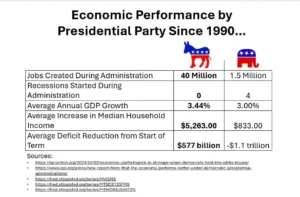
The data is so straightforward that it could be visualized in a single chart: national economic health over time, segmented by administration. Even at a glance, the pattern is unmistakable—growth arcs consistently rise under Democratic leadership and flatten or decline under Republican leadership.
So why is this not the Democratic Party’s most prominent message?
Why is the conversation perpetually reactive, instead of evidentiary?
Why is the narrative dominated by outrage rather than proof?
Corporate responsibility plays directly into this discussion. Republican governance repeatedly prioritizes deregulation, consolidation, and tax structures that overwhelmingly benefit corporations and ultra-high-net-worth individuals while weakening consumer protections, labor leverage, and public oversight. This environment allows market manipulation, systemic risk, and financial extraction to flourish—often invisibly, but always predictably.
Corporate profits soar. Public resilience declines.
This is not anti-business. It is pro-accountability.
Strong economies are not built by removing guardrails; they are built by ensuring markets operate fairly, transparently, and sustainably. Democratic administrations, historically, have governed with that balance in mind. Republican administrations have repeatedly favored short-term financial acceleration at long-term public cost.
Please remember, I am not even a Democrat. I am a full-blown liberal. As a kid, I voted for Reagan, but by 1995 I was working as a part-time volunteer for Ralph Nader in New York City—hence making me the liberal-conservative hybrid I am today.
Yet rather than presenting this record plainly, Democrats continue to bury the most powerful argument they have.
They should not be debating personalities.
They should not be debating headlines.
They should be presenting the chart saying ‘GOP bad’ and ‘Dem’s are great’ in so many words.
A simple, irrefutable visual record of how the nation performs under each party’s leadership and again, dumb it down saying ‘GOP bad’ and ‘Dem’s are great’ in so many words.
I will say it again to articulate it clearly and drive the point home that the GOP performs poorly when in office, and that Democrats consistently have to pick up the pieces of the mess Republicans create over the prior four or eight years. Say it over and over. Repeat it five times a day until the 2026 election. This is not hard to figure out, and it is not hard to articulate.
Democrats need to do the work. They cannot simply wait for Trump to create another daily controversy and then complain about it. He is the president. That is the reality. The response must be strategic, disciplined, and focused on one outcome above all else which is winning elections.
Because once voters see the trend, the conversation changes.
Not emotionally.
Not rhetorically.
Statistically.
Most of all, Econimically.
The facts are not controversial. They are just inconvenient to those who benefit from keeping them out of the spotlight.
The greatest irony is that the GOP and Trump are so effective at messaging that Democrats often fail to rebut it at all. They rarely challenge the narrative directly or even point out when it is untrue. Instead, they allow themselves to fall into the GOP’s framing by simply complaining that it has now been a year and that it is therefore the president’s time to take credit or responsibility.
They do not explicitly state that the underlying claim itself is false. They merely argue that it is ‘his economy now,’ which falls on deaf ears—because most people already understand that the economic conditions of any given year are largely the result of policies implemented by the admin’s changes.
Yet somehow, public blame still lands on Biden, which is a testament to the strength of the GOP’s messaging machine and, simultaneously, an indictment of how weak and unfocused the Democratic messaging apparatus is for years now. The Democrats often appear unsure of what to say or how to respond beyond repeating that it is now Trump’s economy after a year in office.
The fundamental issue—that the original claim is simply not true—is left unchallenged. He did not inherit a bad economy; conversely, he inherited a strong economy already on an upward trajectory. Yet Democrats respond with ‘duh, it’s his economy today,’ and leave it at that. The same dynamic exists in much of the media, which rarely calls the party out directly. Both the media and the Democratsare very much hesitant to confront Trump and the GOP head-on, resulting in a public discourse shaped more by repetition than by factual accountability.
And until that changes, the country will continue repeating a cycle it already has more than thirty years of data proving it cannot afford. Let alone it will continue to go back and forth running campaigns based on what everyone hates about America.
While there isn’t a single official government “scorecard” chart, numerous economic analyses use 1990–2025 data to track performance trends between Democratic and Republican presidencies. This should make it very easy to spell out to us dumb ass’ed Americans. Historically, several key metrics have fluctuated significantly (“up and down”) depending on which party held the White House.
Economic Performance by Metric (1990–2025)
| Metric | Democratic Performance (Clinton, Obama, Biden) | Republican Performance (H.W. Bush, W. Bush, Trump) |
|---|---|---|
| GDP Growth | Averaged 3.9% (Clinton) and 3.2% (Biden) annually. | Averaged 2.3% (H.W. Bush), 2.1% (W. Bush), and 2.3% (Trump). |
| Job Creation | Added over 50 million jobs total across the last three Democratic administrations. | Added approximately 17 million jobs total across the last three Republican administrations. |
| Unemployment | Historically decreased by an average of 0.8 percentage points during their terms. | Historically increased by an average of 1.1 percentage points during their terms. |
| Stock Market | The S&P 500 has seen higher median annual returns of roughly 12.9%. | The S&P 500 has seen median annual returns of roughly 9.9%. |
The historical trend since 1990 indicates that federal budget deficits have generally increased substantially under Republican presidents (George H.W. Bush, George W. Bush, and Donald Trump) and decreased under Democratic presidents (Bill Clinton and Barack Obama). This pattern of “up and down” corresponds with changes in administration.
Historical Deficit Trends (1990-2025)
| President | Party | Term (since 1990) | Deficit Change during Term | Key Fiscal Events |
|---|---|---|---|---|
| George H.W. Bush | Republican | 1989–1993 | Increased by 67% (to ~$255 billion) | Oversaw the “Reagan-Bush” era debt growth and a recession. |
| Bill Clinton | Democratic | 1993–2001 | Decreased by 150%, ending with a $128 billion surplus | Enacted budget reconciliation which led to the only surplus since the 1960s. |
| George W. Bush | Republican | 2001–2009 | Increased by 1,204% (to ~$1.41 trillion) | Enacted tax cuts, launched two wars, and managed the 2008 financial crisis response. |
| Barack Obama | Democratic | 2009–2017 | Decreased by 53% (to ~$585 billion) | Inherited a high deficit and oversaw the subsequent recovery and deficit reduction. |
| Donald Trump | Republican | 2017–2021 | Increased by 317% (to $2.77 trillion) | Enacted tax cuts and managed the major spending increases related to the COVID-19 pandemic response. |
| Joe Biden | Democratic | 2021–Present | Deficit decreased in his first year, though overall debt has risen due to various factors. | Initial decrease in the deficit was followed by increases related to post-pandemic spending and inflation. |
Key Insights
You can find official data to explore these trends on the U.S. Treasury Fiscal Data website or the Congressional Budget Office website.
Key “Up and Down” Trends
Republican administrations since 1990 have consistently presided over significant increases in the federal deficit, both in absolute terms and as a percentage of GDP.
Democratic administrations have, by contrast, generally overseen periods of deficit reduction, with President Clinton achieving a rare budget surplus by the end of his second term.
Major national events like the 2001 terror attacks, the 2008 financial crisis, and the COVID-19 pandemic led to massive, bipartisan deficit spending, often overshadowing baseline trends.
- Recessions: Ten of the last 11 U.S. recessions since 1953 began under Republican presidents. Conversely, Democratic presidents (particularly Obama and Biden) have often inherited these recessions and overseen the subsequent recoveries.
- National Debt: Budget deficits relative to the size of the economy have generally been lower under Democratic presidents since 1990, with Bill Clinton overseeing the last federal budget surplus in 2000.
- Market Volatility: The stock market has historically performed best under a Democratic President with a divided Congress (where the GOP controls at least one house), as this often results in policy stability and slower change.
Data Visualizations & Tools
You can view interactive versions of these “up and down” charts through the following resources:
- Investopedia: GDP Growth by President – Includes a clear timeline chart showing annual growth percentages since 1929.
- Statista: Annual Real GDP Growth (1930–2022) – A bar chart visualizing the year-over-year fluctuations in the U.S. economy.
- U.S. Senate Joint Economic Committee Report – Contains detailed comparisons of job growth and unemployment rates by party.