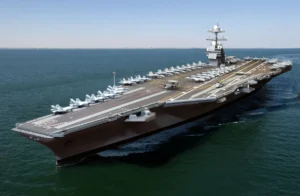
In a time when corporate responsibility should mean prioritizing education, prevention, and rehabilitation, the U.S. government’s approach to the War on Drugs has taken yet another drastic turn. The newest escalation—deploying the USS Gerald R. Ford, the world’s largest warship, to fight drug cartels in the Caribbean—shows just how profoundly the nation’s decades-long War on Drugs has failed.
Think about it: we’ve gone from “Just Say No” commercials and frying-egg PSAs in the ’80s to sending a 100,000-ton nuclear-powered aircraft carrier, complete with F-35s and drones, to blow up suspected drug boats. This is not strategy—it’s spectacle. And it underscores the staggering collapse of any meaningful corporate or governmental accountability in America’s drug policy.
The War That Lost the War
Since the late 1980s, the U.S. has spent well over a trillion dollars fighting drugs. We’ve incarcerated millions—many for nonviolent possession charges—destroyed communities, and yet, drug use, addiction, and overdose rates have only grown worse. The supply never stopped; it simply shifted. And the demand? It’s higher than ever.
Now, instead of reforming what’s clearly broken, we’re doubling down militarily. The Ford Carrier Strike Group—a naval force designed for warfare against nations—is being used to intercept drug runners in fishing boats. The government claims this is part of a “non-international armed conflict” against cartels, calling traffickers “unlawful combatants.” But when we start labeling drug smugglers as enemy combatants, we move even further from justice and closer to a corporate-militarized version of law enforcement—one that prioritizes power and profits over people.
The Human Cost of a Corporate War
This war has always been corporate at its core. From private prison industries that profited off mass incarceration to pharmaceutical companies that sparked the opioid epidemic, the story is the same: money over morality. The corporations that helped fuel addiction are now the same ones investing in “recovery programs” and “law enforcement technologies.” Meanwhile, communities—especially those of color—continue to pay the price.
If the “War on Drugs” were a business, it would be a failed one—except that it keeps turning a profit for the right people. Every missile launched, every contractor deployed, every surveillance drone purchased means billions more flowing into the defense-industrial complex. It’s not about saving lives—it’s about sustaining budgets.
The Real Solution Was Never Violence
The real solution was, and still is, education. Honest, science-based, emotionally resonant education that tells the truth:
- Cocaine ruins relationships and mental clarity—it doesn’t enhance them.
- Opioids and heroin may feel euphoric once or twice, but they hijack your brain until you need them just to feel normal.
- Addiction doesn’t discriminate; it dismantles lives quietly, from within.
If we had invested even a fraction of the military budget used to fund this so-called war into honest drug education, prevention, and mental health programs, we wouldn’t need an aircraft carrier patrolling the Caribbean.
Legal and Moral Recklessness
Beyond the moral failure, there’s a legal one. Under international law, the use of lethal force against suspected drug boats violates the UN Convention on the Law of the Sea and basic principles of human rights. The idea that a group of suspected smugglers—many of them poor fishermen coerced by cartels—can be executed from the sky without trial should horrify anyone who believes in due process.
Even within U.S. law, the President’s unilateral authorization of these attacks stretches, if not breaks, constitutional limits. The War Powers Resolution was designed to prevent precisely this kind of unchecked military adventurism. Yet here we are again—no congressional approval, no public debate, just executive action under the guise of “national security.”
Corporations, Governments, and the Illusion of Control
This entire effort exposes how corporate and government interests intertwine under the banner of “public safety.” It’s not just about drugs—it’s about control. Control of resources, control of economies, and control of narratives. The War on Drugs has always been a convenient excuse to militarize police, surveil citizens, and keep entire populations marginalized.
And as long as the money keeps flowing—to defense contractors, private prisons, pharmaceutical giants, and politicians—the war will continue.
The Real “People” in This War
If corporations are people, as the infamous saying goes, then these “people” have blood on their hands. They’ve profited from addiction, incarceration, and now from warfare. True corporate responsibility would mean funding treatment, supporting education, and dismantling the systems that perpetuate this endless cycle. Instead, they’ve handed us another war we can’t win.
So maybe the question isn’t just whether the War on Drugs has failed—it’s why we keep pretending it hasn’t. Because at the end of the day, when your solution to a social issue involves a nuclear-powered aircraft carrier, you’ve already lost.